
Table Of Contents
Why make the trip?
What is your background?
What is your route?
Who is your horse?
What wild horses does New Zealand have?
What gear are you using?
Saddle
Pad
Boots
How do you feed & water your horse?
Where do you camp?
How do you contain your horse overnight?
How will you care for your horse?
What are the major difficulties you anticipate?
Will you use a support vehicle?
Are you on social media?
How do you afford this?
What happens to your horse at the end?
What if your journey isn’t a success?
Predecessors
Where can I learn more about long riding?
“3 countries, 3 wild horses”
I have a passion for long riding with wild horses. So far I have traversed the length of two continents, North America and Oceania, a collective 6,200 miles / 10,000 kilometers.
My maiden voyage was across the USA with my mustang, Finley, in 2022-2023. I then embarked across Australia with my brumby, Fable, in 2025-2026. Both were wild upon me meeting them, and were trained over a ~100 day period immediately before departing for their respective journeys.
New Zealand having their own herds of wild horses is what has entirely inspired this new adventure.
I am excited to explore the country, the culture, and all the little things that make it a wonder. On the road, you never know who you’ll meet, what you’ll see, what opportunities will come your way, and these unknowns are what make adventuring so unbelievably, uniquely beautiful. There’s nothing quite like it, really.
Most of all, I look forward to forging a bond with a new horse, to live side-by-side with them every day and night, to see what’s beyond the horizon together. There is no way to be closer to your horse than to be a part of their herd, truly. To have such a partnership is my greatest motivation. I do all of this for the love of a horse.
Adventure has defined the last seven years of my life. (Gosh, I can’t believe it’s been that long!)
I walked across America at the age of 18-19, having never left home before, overweight and awkward with $500 to my name, and it stirred something in me. It gave me spirit.
At 20, feeling trapped and having lapsed into a depression, I took off on my bicycle to cross the country again.
Revitalized from this, I rode across the U.S. on my mustang, Finley, next. I had never ridden a horse, and he had been wild and untouched by humans a few months prior to our meeting, yet we prevailed.
After an unfulfilling stint at college, I paddled the Yukon River at 24, and it was this last voyage that made me realize that I wasn’t ready to settle down yet.
So then I traveled overseas for the first time to adopt a Brumby, Fable, and ride across Australia.
When not adventuring, I work at entry level, menial jobs (retail, food service, housekeeping, etc.) to save for the next one.
Long riding in particular has captured my heart so wholly because it allows me to combine my two greatest passions: animals and adventure. I have known no greater love outside of my family than from my furry, four-legged friends.
I am riding from the top to the bottom of New Zealand, across both the North and South Island. Cape Reinga to Bluff, a distance of approximately 1,800 miles (3,000 kilometers).
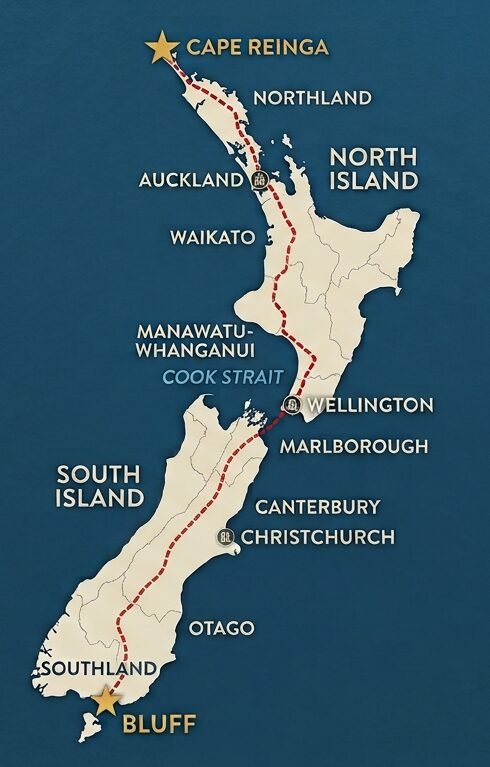
I anticipate the journey taking 6 months, between October 2026 and March 2027.
We’ll pass through the following regions, in order:
North Island
- Northland
- Auckland
- Waikato
- Manawatu-Whanganui
- Wellington
South Island
- Marlborough
- Canterbury
- Otago
- Southland
This map is not designed to be accurate, just approximate.
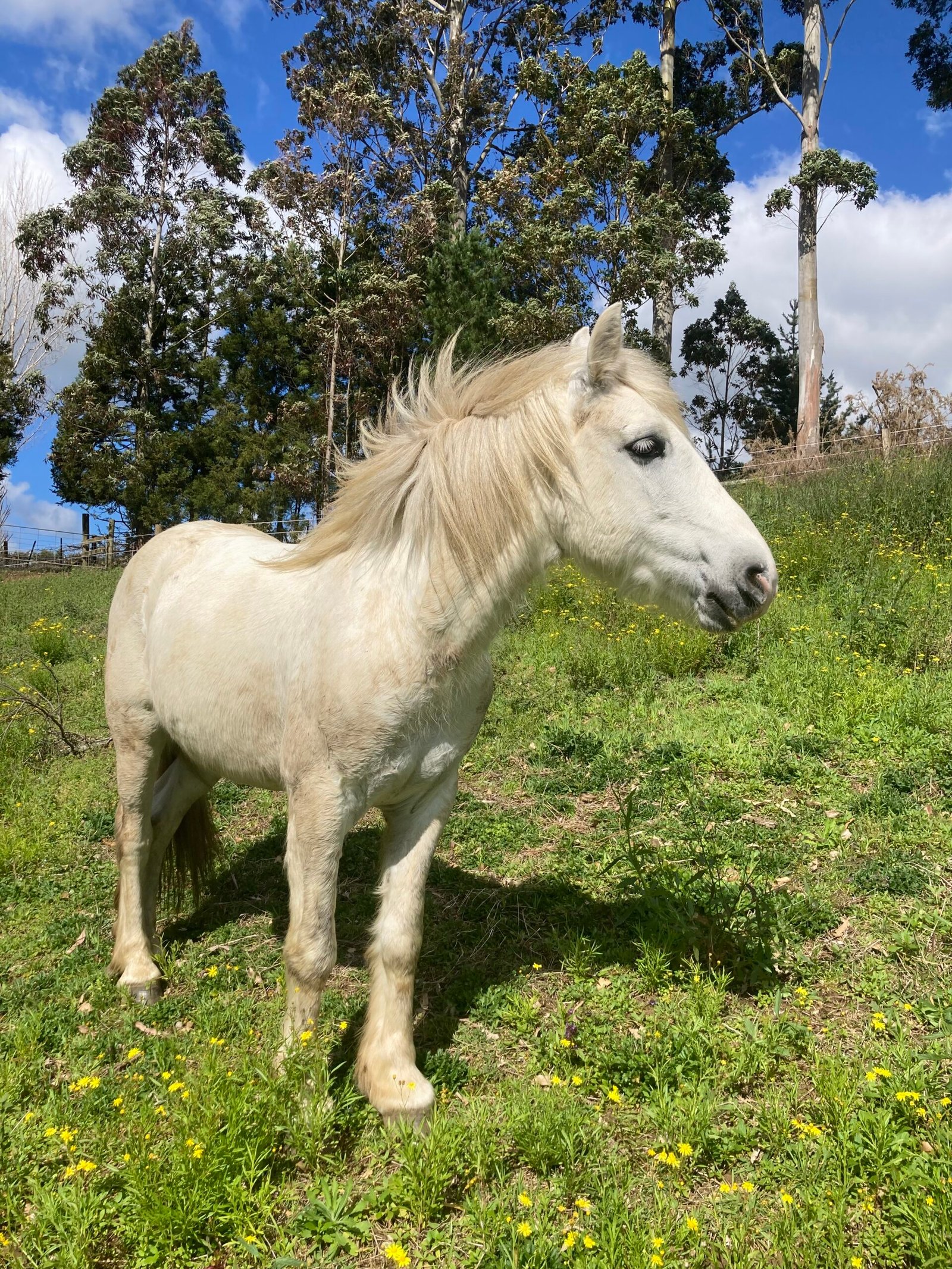
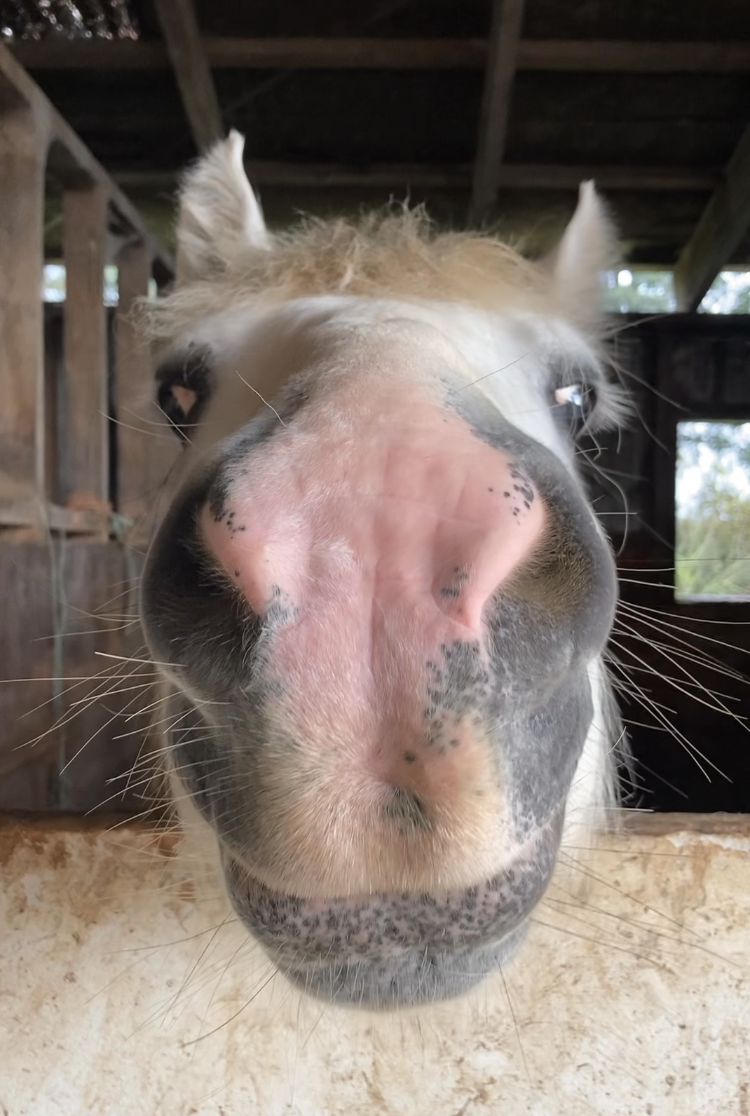
Falkor is a white Northland Horse, hailing from the 90 Mile Beach area. Named after the luck dragon from The Never Ending Story, befitting the Year Of The Fire Horse. He is approximately 8-10 years old and 14 hands tall “with boots on”. Built stocky like a Welsh Cob, with a stoic personality. He was captured from the wild in mid 2025 with a bachelor band aka other roaming stallions.
His nickname is Pony Bear, and he loves having his belly button scratched.
What wild horses does New Zealand have?
New Zealand has a smattering of wild herds, the most prominent being the Northland Horses and Kaimanawas, named after their respective homelands.
Northland Horses, or “bush ponies,” roam in isolated pockets across Northland, particularly along the coast, with 90 Mile Beach home to the largest population. They live across a checkerboard of public and private land with most being managed by local Māori tribes. Herds are mustered at random, often in spring or autumn, and are driven into corrals by mounted horsemen. They possess a diverse range of coat colors—including bay, chestnut, gray, black, and pinto. The Wild Horse Project in Waipapa serves as the primary rehoming and advocacy group for these horses. Interestingly, despite being lesser known, Northland Horses actually outnumber Kaimanawas.
Kaimanawas, naturally, inhabit the Kaimanawa Ranges on part of an active military base. Their numbers are kept in check through routine helicopter roundups, typically in autumn. They are overwhelmingly bay in color, with some chestnuts, gray, and blacks. Two main charities exist to promote them: the Kaimanawa Heritage Horses, which has sole authority to handle all initial re-homing logistics, and the Kaimanawa Legacy Foundation, which runs an annual Stallion Challenge (like a Mustang Makeover) at New Zealand’s largest equine venue, Equifest. Thanks to this great advocacy, the Kaimanawas enjoy broader recognition and public support than their lesser known northern counterparts.
For a detailed analysis on my gear, stay tuned. I will be releasing videos on the subject soon.
|
|
|
|
|
|
I am not sponsored by any company.
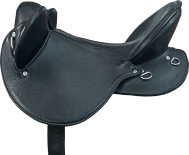
I am using a Franco C saddle, their Addax model. It’s the same saddle I had on my ride across Australia.
I appreciate that my saddle is lightweight with a degree of adjustability, a thoughtfully designed tree (open shoulder clearance, wide spinal channel, maximum panel contact, etc), a secure seat, and skirting with d-rings to attach my saddle bags to.
I only wish my saddle’s tree were made of carbon fiber to shed weight, and that it had dual rigging, allowing for a front and back cinch. In fairness, Franco C will readily customize new saddles to accommodate customer requests. I simply bought one of their standard models, used.
Pad
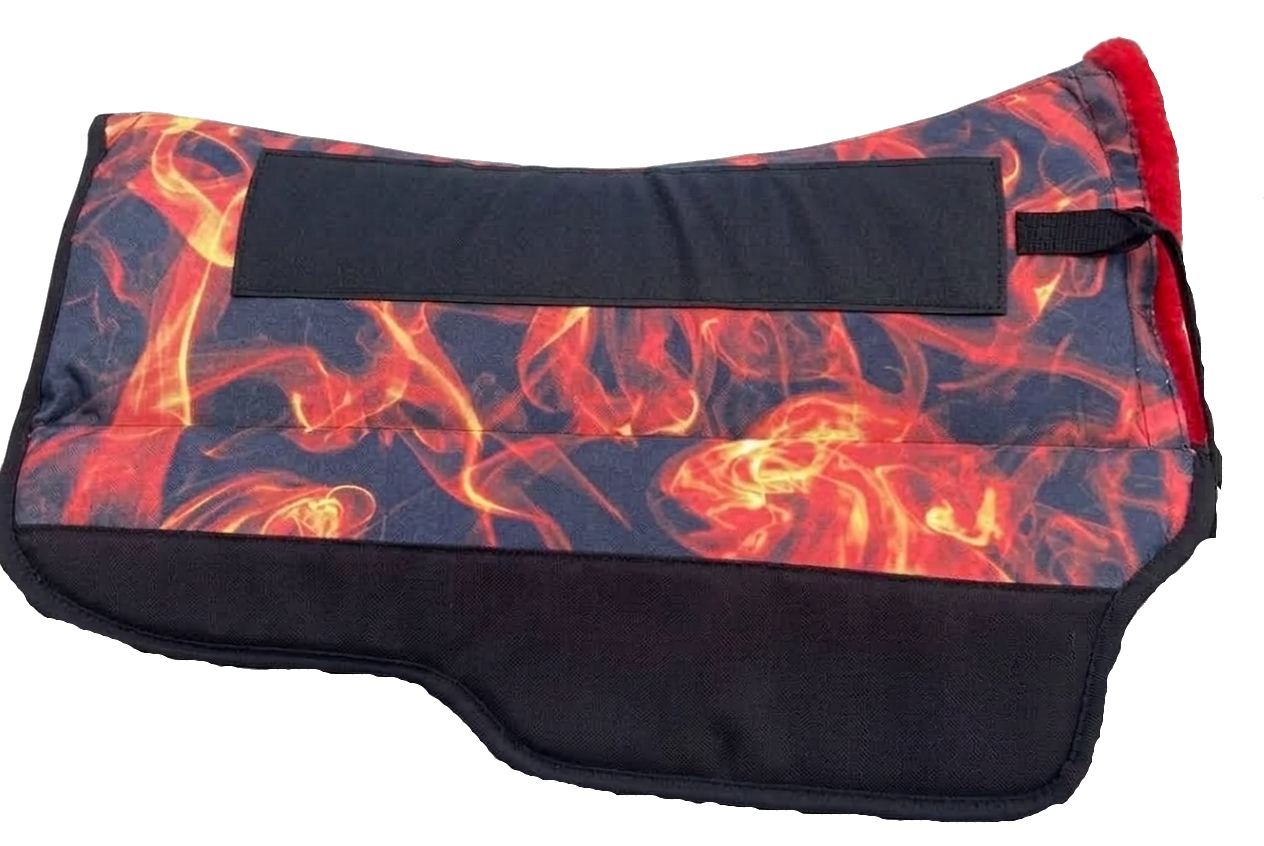
I’m using a custom Skito pad, the same brand I used on my Australian long ride. Topside, it has waterproof condura fabric with “no slip strips” and “tie on straps”. Bottom side, it has 100% merino wool fleece and wool felt, half and half. Inside are 3/4th inch memory foam inserts. It is 26 inch in length.
Boots
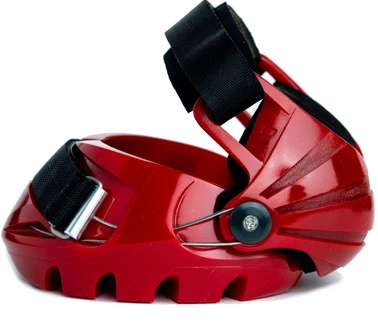
Renegade Vipers, the best brand on the market and the one I have used for all of my expeditions! They provide excellent adjustability, stability, durability, and support. Each boot typically lasts 1,000-1,3000 miles (1,600-2000 km).
For this journey, I am going to try replacing the traditional Velcro straps of Renegade boots with “voile” polyurethane straps and will let everyone know how they compare!
Falkor will be sporting dragon fire red boots.
How do you feed & water your horse?
I will primarily be grazing my horse along the way, with occasional access to hay or hard feed when it is made available.
I do not anticipate needing to carry feed ever, though I would if circumstances demanded.
This is because New Zealand is the land of year-round greenery! Even in winter, or during droughts, there’s some semblance of green in the low lands. New Zealand’s idea of a drought is like a wet year in Australia.
Similarly, water sources should be so abundant as to make caching water unnecessary.
This will be one of our greatest struggles in New Zealand! Most of Australia, and much of the U.S., has swathes of public land to readily camp on. While New Zealand is heavily privatized with the shoulders of roads, “right-of-ways,” being too narrow to pitch a tent. ALL national parks and most Department of Conservation (DOC) land also prohibit horses. No matter, we’ll camp on public land when we can, and seek permission from private property owners to camp on their farmlands when we can’t. Trying to network online will be important to facilitate stays.
How do you contain your horse overnight?
When I don’t have access to a contained space–like a fenced-in pasture, corral, or stall–then I tether/picket my horse!
Of all the options available, such as high-lining, hobbling, or corralling with an electric fence, none are as versatile for long riding as tethering, aka picketing. It secures a horse while allowing for free, and maximum, range of movement, so that they can happily walk around, even trot, and lie down to sleep.
I tether by a front pastern with my “rope” being 45 feet (14m) of 3/4 inch (19mm) beta biothane. Neon yellow for visibility.
Biothane is superior to every other rope material (cotton, poly, nylon). It is the most lightweight and compact, does not coil on itself, and is completely waterproof so as to not absorb moisture from morning dew, rain, etc. Biothane is stronger than leather, yet a knife can slice through it easily in an emergency. Equally, it pairs well with a biothane hobble.
How will you care for your horse?
- We will take 1 to 2 rest days per week.
- We will take a 10 minute break for every hour of riding. (This long riding principle is adopted from the cavalry.)
- We will take an extended break between the North and South Island, likely 10-14 days off.
- We will aim to ride 15 to 20 miles (24 to 32 km) a day, with the exact amount contingent on how my horse is feeling.
- I will walk a portion of our daily mileage, between 1/3rd and 1/4th. (The percentage is actually far greater in the beginning. I always start my horseback journeys walking lots in the beginning, and only gradually increase the amount of riding as my horse becomes conditioned.)
- My horse will carry no more than 20% of their body weight, the global standard
- My horse will have vet and farrier visits when needed
-
I will carry a portable luggage scale to ensure my saddle bags are even in weight every day
-
I will carry an emergency locator beacon and wear a high vis jacket for road riding
-
My horse will be equipped with an ID tag and his own satellite tracker
What are the major difficulties you anticipate?
The big four:
- Traffic–Undeniably the greatest danger to us. Roads in New Zealand are notorious for being narrow and windy. This is why solid route planning will be critical.
- A lack of accessible campsites–Being a small island nation, New Zealand is congested, and exceptionally hilly, with most land being private, or public but prohibitive to horses. As a result, I will need to network online or knock on the doors of farmers regularly to find places to camp. I will confess, this is the aspect of the journey I look forward to the least.
- Rain–New Zealand is known for its rainy weather, with a climate similar to Seattle. There’s nothing worse than being wet for prolonged periods, so I am carrying a high-quality rain jacket + rain pants and I promise to be a “weather wimp” in lying low on stormy days as much as I can manage. On the bright side, temperatures are mild from spring thru autumn in the lower elevations.
- River crossings–A unique obstacle, more so in the South Island than the North Island.
It is our beginning in Northland that will be the hardest part by far, lasting 3-4 weeks!
Will you use a support vehicle?
No, a support vehicle is unnecessary given the abundance of natural graze and water sources in New Zealand. However, if there are any roads or river crossings too dangerous, we will happily catch a float / trailer ride to avoid these areas.
Yes, I am on Facebook! My page is called Onward, Always.
I am considering having an Instagram, TikTok, and YouTube. Though, in all honesty, I would plan to employ a “dump and run” approach on these other platforms. Posting my content and then quickly logging out with little effort given to scrolling to limit my daily social media use while still sharing my story to a broader audience. “Life is better offline!”
Facebook is the main platform I will manage and monitor with frequent updates. I am best contacted through Messenger or email ginandfaith@gmail.com .
I alternate between working entry level jobs for a few months, and adventuring, with all my time and energy going to fund the latter. Total immersion. And if I ever run out of funds mid-trip, as I often do, I quietly put the rest on a 0APR credit card, to be immediately paid off in full by working again after the journeys close. I am happy to do this. Most recently, I spent 8 months working in between my long ride across Australia and this one in New Zealand.
I haven’t planted roots in life yet, unlike the majority of people. I don’t have a family, kids, house. I’ve never even had my own car. I like to joke that, on any given year, I hustle to make just enough money to either buy my first junk car, or go on another adventure. And, well, you can see which option I keep choosing …
As I like to joke, “I’m not rich, I’m just crazy!”
What happens to your horse at the end?
Falkor will be available for sale to a loving home.
Unfortunately, being a foreigner to New Zealand on a temporary visa, I must part ways with Falkor after our journey. Though I would love to stay in touch with his buyer.
While I have made a commitment to bring my Australian Brumby, Fable, home to the USA, an endeavor I will spend years working towards, sadly, I cannot extend the same promise to Falkor.
Nonetheless, with long riding, it’s always my intention for my horse to finish in better condition, both physically and mentally, than they started. That’s the beauty of long riding. When done right, it’s mutually beneficial for both horse and rider, getting both in peak shape.
This is particularly true with my journeys. I intentionally take on wild horses that can hardly be touched let alone haltered, and put the hard work — thousands of hours of blood, sweat, and tears — into making them accomplished, bombproof mounts that anyone would be fortunate to own.
What if your journey isn’t a success?
Oh well!
My objective with this adventure is to give it my all while never losing sight of the fact that it’s all for FUN! 😁
And fun can be found in failure too.
I’m at a point in my life where I now have multiple successful adventures under my belt, so I don’t feel compelled to “prove” anything, least of all that I can go the distance. Rather, I take on challenges like this because long riding is my passion, and I know I can find fulfillment in trying so long as I put my animals first.
To that end, my commitment is to the well-being of my horse. Whether I have just begun my journey or am nearing the finish line, if my horse is unable to continue for whatever reason, I will respect that and call it quits, knowing that I have still succeeded in the only way that truly matters. “The journey,” to me, is not really about going from Cape Reinga to Bluff. It lies in the bond forged with my horse. Time and money will be a fair trade for the experience regardless of whether we make it top to bottom.
I like failing if it means I get to be out there in the world really living rather than wasting away in my bedroom on a computer screen. I like failing if it means I get to grow. I like to find humility and humor in disaster, to get into some good trouble, provided no one gets hurt. A mindset I’m not always capable of achieving in the moment when s– is going down, but in hindsight? Hell yes. I think back to when my mustang Finley ran away with me over an Amish buggy in Ohio, or when he and I were charged by buffalo in South Dakota, plus a million shenanigans in between, and such memories crack me up, they are so endearing to me. I love a good story.
And I love to think, “If it’s not meant to be, better things are!”
Predecessors
North and South Island
- Richard St. Barbe Baker–74 year old Kiwi man, 1963.
- Warren Potts—man, unknown nationality, 1988.
- Robin & Louella Hanbury-Tenison—UK-based married couple, 1988. Founding members of the Guild and prolific long riders. Book: Fragile Eden.
- Tracey Elliot-Reep—English woman and unnamed partner, 2000. Book: Riding By Faith.
- Mary Pagnamenta—English woman (now Kiwi/expat), 2001-2002.
- Kerrin & Genevieve Revell—Kiwi couple with support vehicle, 2007-08. Book: Down, Across & Up
- Thierry Posty—French man, ~2006, unknown if he completed both islands. Prolific long rider.
- Pete Langford—Kiwi man, 2012-13. Social media: “Free With Every Horse”.
- Lou McNutt—Kiwi woman, 2017-18. Had Kaimanawa horses.
South Island Only
- Jeanine McDonalds—Kiwi woman, 2015. Social media: “southislandtrek.blogspot”
- Maxence Benoist—French/Kiwi woman, 2015-16. Social media: “Braided Manes, Braided Tales”
- Blythe, Jade, & Michelle—three Kiwi women, 2015-16. Social media: “Three Girls Six Horses”
- Jessica Mullins & Bijmin Swart—Kiwi couple, 2020. Social media: “Rewild Project”. Had Kaimanawa horses.
- Karolin Van Onna & Nicole Kumpfmueller—two German/Kiwi women, 2023. Social media: “nzonhorseback”
- Katie Herries—Kiwi woman, 2023. Social media: “A Long Ride South”.
- Marie Palzer—Kiwi woman, unknown year.
Miscellaneous
- Larissa Mueller—Kiwi woman, 2012-2021, rode the circumference of NZ. Completed in small sections over nine years. Social media: “homefree”
- Heather Hilton-Jones—65-81 year old Kiwi woman, 2009-2024. Completed in small sections over fifteen years. Had a Northland horse.
- Trek For Life Aotorea—large charity ride across both islands, varied participants. Completed in small sections over 8 years (ongoing) with full support crew. Social media: “Trek For Life”.
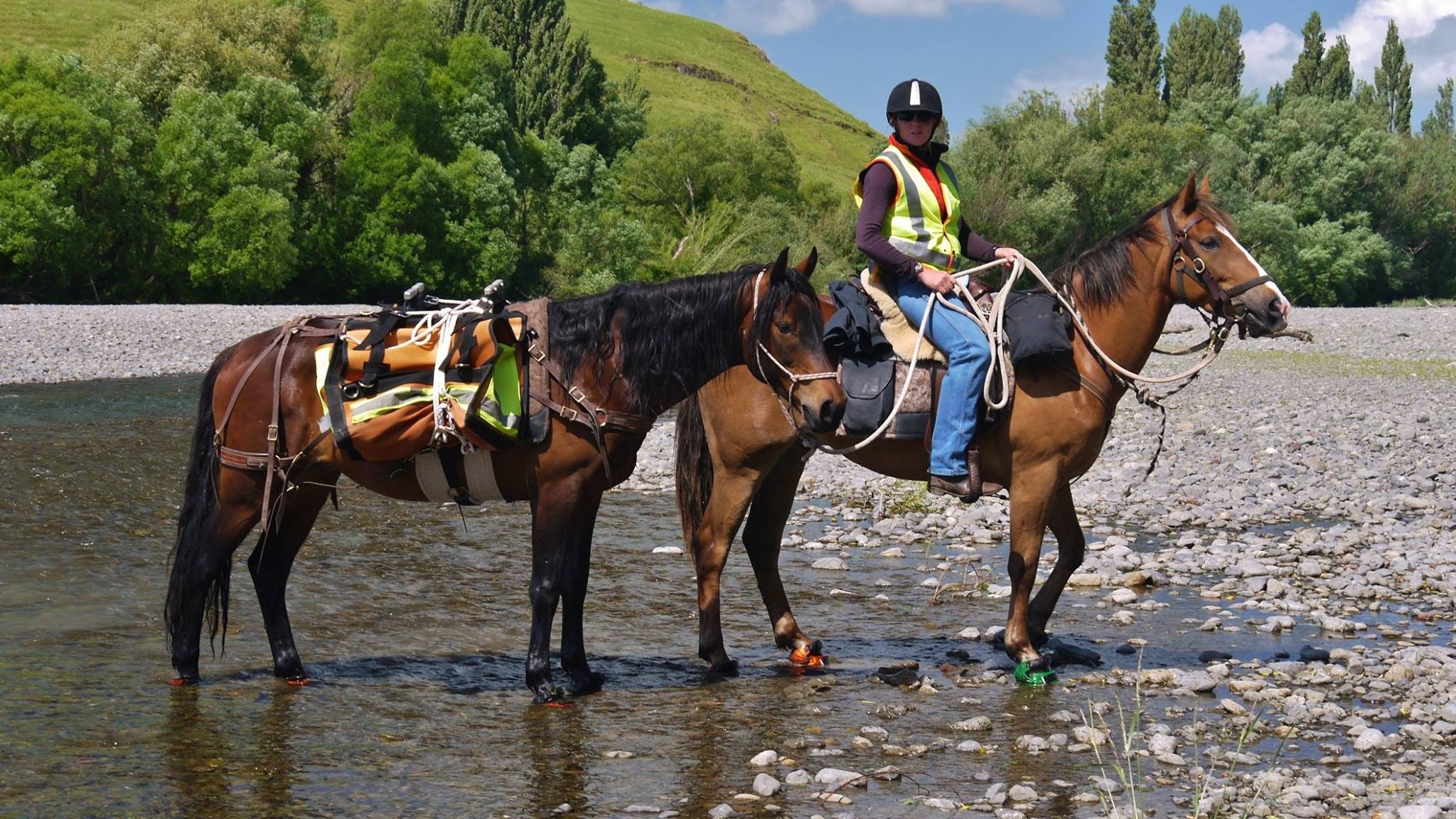
Lou McNutt with her Kaimanaws, photo credit to her
Where can I learn more about long riding?
Long riding is traditionally defined as a continuous ride of at least 1,000 miles (1,600 kilometers), unaccompanied by a support vehicle/team unless it is deemed vital.
The Long Riders Guild is the international association for such equestrian explorers and its website has the greatest repository of horse travel stories in existence. I am a LRG member as of 2023.
I highly recommend checking out their guidebook, The Horse Travel Handbook.
“A visit inside [the Long Riders Guild] will introduce you to the amazing men and women who have ridden horses in search of mounted adventure in every conceivable country and climate, ranging from Africa to Antarctica.”